Showing posts with label spica. Show all posts

Tuesday, April 15, 2014

Lunar Shadow Dancing: April's Total Eclipse Highlights

Staff Writer, DL Mullan
Photographer, DL Mullan
Lunar Eclipse / Astrophotography
____________________________________

Just in case you missed the total lunar eclipse, here are some highlights:

The Moon enters the Earth's penumbra.

Slowly the Moon is covered in darkness.
Halfway to Totality.


The moon remained red and in the Earth's shadow for over an hour. A very impressive evening watching the movement of the planet and her satellite.

Mars was the closest to Earth for the entire year tonight and during the total eclipse was brighter than the moon. Spica even got in some sparkle time while the brightness of the moon was veiled. Saturn pulled up the rear as he traveled through the elliptical plane around the sun.

  
Refracted Light is about to Disappear.
Jupiter and Orion had already set for the evening before the Moon went into the Earth's shadow. 

A very good night for skywatchers.

Tuesday, April 8, 2014

Earth's Eclipse and Mars Opposition

Staff Writer, DL Mullan
Astronomy / Astrophysics
__________________________________

Even though the Earth cannot play host to an eclipse on Mars by going in between the Sun and Mars this evening, it is the same principle as our Moon interfering with our sunlight.

Tonight is one of those rare nights that the Earth and Mars are incredibly close. The red star in the Eastern to midheaven sky is Mars. 
Mars is bright now! It’s easy to see with the unaided eye from all parts of Earth – as bright as the sky’s brightest star. Mars is brighter than it’s been for six years, since December 2007.
And that's not all skywatchers: 
Quite literally, this is Mars’ day in the sun. Take advantage, for Mars won’t be returning to opposition again until May 22, 2016.

By the way, Mars is not precisely closest to Earth on April 8, the day of opposition. Our two worlds will be closest together on April 14. On that night, Mars and the star Spica will appear near the moon as the moon undergoes a total eclipse!
 
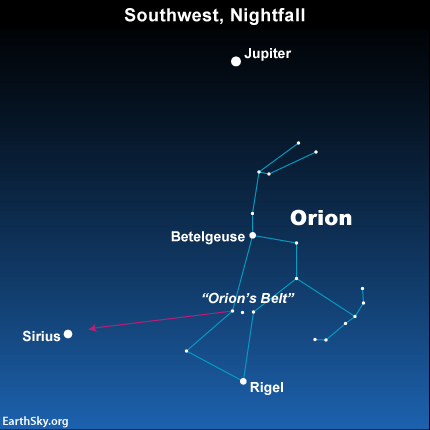
And to the West, view Orion, Spica, and Jupiter.

So break out those binoculars, telescopes, and dslr cameras, this one is for the history books. Well, at least your sky diary.


Source: EarthSky,